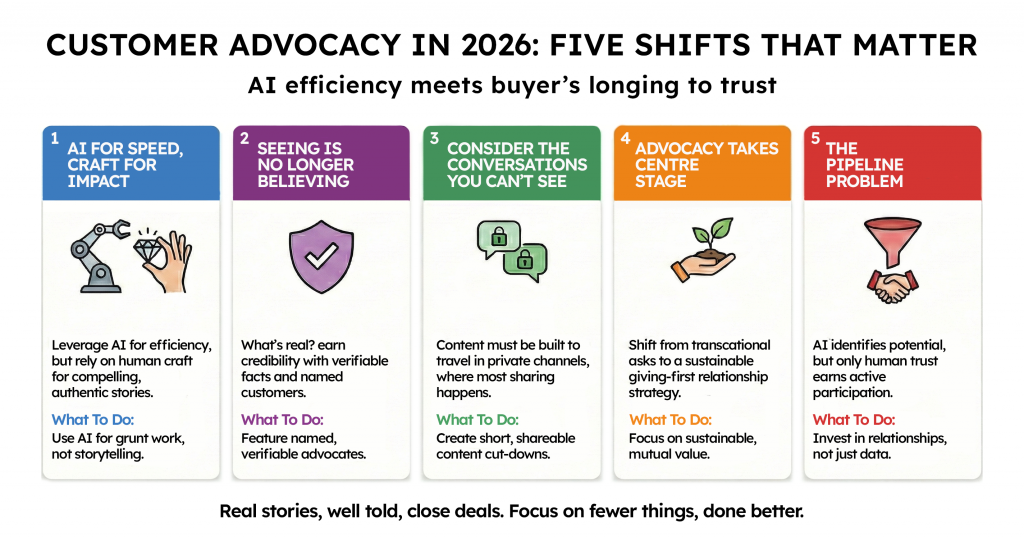
The rules of customer advocacy have shifted. AI is accelerating everything while buyers have grown more sceptical of polished corporate messaging and unnerved by AI fakery.
1.AI for Speed; Craft for Impact
AI can now pull testimonials from call recordings, turn them into drafts and videos, and tailor customer stories for different audiences. The technology is genuinely impressive.
But speed without credibility is just noise. The teams getting this right are using AI to handle grunt work, while creating great customer storytelling experiences; using craft and skill to combine art and science to create compelling content in a flood of stuff/AI slop.
That means interviewers who can create a great experience, and editors who can turn raw output into gold.
That’s the balance: let AI do more, but don’t let it replace the authenticity and customer experience that make customer stories work in the first place.
Faster isn’t better. Better is better.
What to do: Use AI to identify advocates, help draft initial content, and perhaps personalise and/or scale distribution. Then invest the saved time in making your stories even better, and deepening customer relationships.
2. Seeing Is No Longer Believing
Video used to be the ultimate proof. A real customer, on camera, telling their story; what could be more compelling (other than face-to-face conversation)?
The whole world is unnerved. We all know that AI can fabricate faces, voices, entire stories. We’re warier. Seeing isn’t automatically believing anymore.
Yet the use of new tools opens up possibilities when used with integrity.
Perhaps trust has to be earned differently. Named customers at verifiable companies. Stories with specific, checkable detail. People who exist on LinkedIn and will stand behind what they said. The video is just the surface; the credibility runs deeper.
What to do: Feature customers who are happy to put their name to their story. Get specific; real numbers, real outcomes, real context. That’s what resonates now.
3. Consider the Conversations You Can’t See
Prospects are making decisions in places that are impossible to track. Research suggests up to 84% of content sharing now happens in private channels, such as Slack threads, WhatsApp groups, and LinkedIn DMs; not public feeds.
And the buyers have changed. Millennials and Gen Z now make up 71% of B2B decision-makers. They prefer to do their own research and trust peer recommendations over sales pitches.
So, customer stories need to be built to travel. They need to work when someone forwards a link to a colleague with “worth a look.”
If the best customer content only lives on a website, it’s not going easily to where the decisions are made.
What to do: Create content cutdowns designed for sharing; short, specific, easy to forward. Refocus on communities, especially where customers can talk to prospects. And accept that some of the most effective advocacy will happen where we can’t measure it.
4. Advocacy Takes Centre Stage
Nearly half of marketing decision-makers now rank customer experience and retention as their top priority – ahead of acquisition (Madison Logic/Harris Poll, December 2025).
If retention is the priority, then creating advocates is the work. Not as a marketing nice-to-have, but as a core business strategy.
But here’s where many programs go wrong. They confuse reference programs with advocacy programs. Reference programs ask: “What can we get customers to do for us?” Advocacy asks: “How do we build a sustainable relationship?”
This matters. Advocacy that gives before it asks is advocacy that lasts.
That’s why we created the SANE framework: Status, Access, Networking, and Education. Give customers visibility. Give them access to people and ideas. Connect them with peers. Help them learn and grow. Do that, and the stories, references, and referrals will follow naturally.
What to do: Audit your current programme. Are you extracting or investing? The metrics that matter are changing. Relationship strength (long term) is as important as sales impact (short term). Be honest. If every customer interaction starts with an ask you have a reference program, not an advocacy program; perhaps it’s time to rebalance.
5. The Pipeline Problem
The bottleneck has moved. It’s no longer “How do we create enough content?” It’s “Who will actually participate?”
Layoffs have thinned customer contacts. Job insecurity makes people cautious about public visibility.
And it’s not just the customer side. B2B tech marketing teams have been decimated too. Fewer people doing the outreach, nurturing the relationships, managing the programs. Both sides of the equation have shrunk.
The tool vendors have an answer; mine calls and account data for positive sentiment, then auto-generate testimonials. Pipeline solved.
Not quite. Identifying someone who said something nice is not the same as earning their participation. Positive sentiment on a call isn’t permission to quote. A happy customer isn’t automatically a visible advocate.
These tools can help you find potential. But potential isn’t pipeline. The real work is still relational: giving customers reasons to say yes, making participation easy, and creating an experience worth their time.
What to do: Use the tools to identify. But invest in the relationships that convert. The bottleneck isn’t data — it’s trust.
Summary:
The fundamentals haven’t changed. Real stories from real customers, told well, still close deals. What’s changed is the context; tighter resources, warier buyers, and a flood of forgettable content.
The teams that win in 2026 will do fewer things, better.